
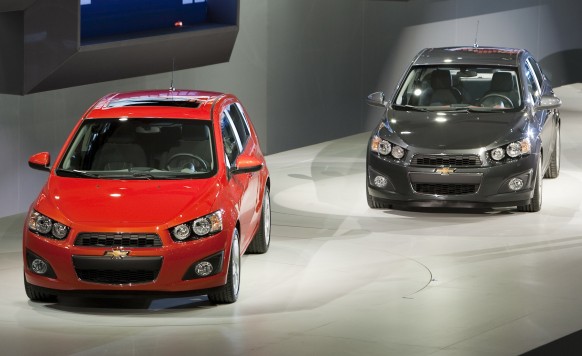
GM has big hopes for the small Chevy Sonic
The Chevrolet Sonic subcompact represents a chance for redemption for General Motors and the UAW, which are seeking to prove the company and its organized U.S. work force can work together to build a small car profitably.
The Sonic launches next month in GM's Orion Township plant as the smallest car assembled in the U.S.
It builds on the dubious legacy of GM's last UAW-built subcompacts, the disappointing Chevy Vega and the better Chevette of the 1970s and 1980s. Chevy's most recent subcompact, the Aveo, imported from Korea, screamed "econobox."
GM struggled to make money on those cars, which were often viewed as stripped-down, unattractive rides.
So when UAW and GM negotiators met ahead of the automaker's 2009 bankruptcy, as the union accepted frustrating concessions and GM fought to stay alive, the idea surfaced: Why not try to build a subcompact profitably in the U.S.?
Two years later, the UAW has agreed to cut labor costs by paying 40% of Orion's hourly workers half the standard $28-an-hour wage. GM gutted the factory to retool it for many of GM's most efficient processes.
And a group of GM engineers has taken the Sonic's global version and fought to improve it, committed to offering a product that can transform GM's small-car reputation.
"The last car sold on cost," Sonic development engineer John Buttermore said. "This car will sell because it's great."
'A no-compromises car'
Excuse General Motors development engineer John Buttermore for this abrupt beginning to his presentation about the Chevrolet Sonic, but Buttermore said he "had to fight like hell" to get senior leaders to approve the wheels. That took about a year, but he said the victory will cut the extra road noise that comes with steel wheels.
"This is a no-compromises car," Buttermore said. "People coming into this segment don't want a bad car anymore."
The Sonic engineering team's pledge to create a better small car combines with cost-cutting efforts in manufacturing and labor to give GM a chance to redeem its subcompact legacy, both in profitability and quality. Both the automaker and the UAW are seeking to prove their relevance as high oil prices are expected to send more U.S. consumers to newly stylish small cars.
The UAW has agreed to give the Sonic's Orion Township plant a record percentage of lower-wage entry-level workers, seeking to promote job growth and shed its members' image as an expensive liability for Detroit automakers. And GM engineers have totally remodeled Orion, making room for two suppliers and an in-house warehouse and putting parts at arms' reach for workers.
GM has declined to give details on the Sonic's profitability. But Mark Reuss, president of GM North America, said in October that the car would be profitable within its first life cycle, often five to seven years.
Ready to face tough competition
Design analysts view the Sonic as an improvement over the outgoing Chevy Aveo, whose name GM dropped for the new U.S. model partially to help divorce the two versions. Still, the subcompact segment has strong new competitors such as the Ford Fiesta and Hyundai Accent. And Chevy has not led U.S. subcompact sales since the current Nissan, Honda and Toyota models entered the market in 2006.
So when Buttermore and chief Sonic engineer Joaquin Nuño-Whelan first drove the global version of the Chevy subcompact in 2009, they decided the U.S. model needed a little more work.
"Getting people to take small cars seriously in the U.S. is a huge deal for us," Nuño-Whelan said.
Buttermore, who on weekends channels his passionate personality into racing Corvettes, started pushing right away to make the alloy wheels standard instead of an option. The approval took about a year.
"They were predicting they would build 60% of the cars in North America with steel wheels, and I just lost my mind," he said. "We're talking about quiet ride. ... A steel wheel has a lot of ringing noise."
Another fight to improve the car got a part nicknamed after him: The Buttermore Braces, as they're fondly called at GM, are a method the U.S. team created to tie the engine cradle and the body structure together. The braces make the car's foundation stronger while allowing for a softer ride.
Still, the Sonic is a tiny car with a starting price of $14,995, including the delivery charge, which is $1,000 more than the Mexico-built Ford Fiesta. So Buttermore said he chose to be a "battle-picker." For instance, he passed on further improvements to the sealing around the car's doors.
"In this car, we're finding the weaknesses and making them better," he said. "In sealing, we're already excellent."
Fun and frankness part of job
The Sonic team has young leaders -- Buttermore is 31 and Nuño-Whelan is 33 -- and the engineers say their frankness is an integral part of the car's success.
"If you surround yourself with people who are passionate and who always say what they think, you get results way faster," said Nuño-Whelan, who founded Green Place Detroit during GM's bankruptcy to teach students from the Cesar Chavez Academy charter school how to use green engineering for urban gardening and home building.
Testing all their suggested changes meant hours and hours of road testing -- and plenty of fun for the young team. After two weeks of mountain and desert road testing this spring, the engineers regaled listeners in a storytelling session over dinner.
They joked about the body odor of a camera guy sent to chronicle their trip. They exalted over discovering stick-on mustaches -- for only 50 cents! -- in the candy dispenser of a gas station and schemed about their plans to grow mustaches during an intense development period on a future project.
They laughed about Buttermore's three-course meal purchased at a gas station on a particularly long drive, when the engineer was informed they wouldn't stop for lunch. The three courses? A Nature Valley granola bar, a Cinnabon snack bar and a Tiger's Milk protein bar. (He chose the latter because it had "Tiger's" in its name, but said it was painful to eat.)
As the engineers weighed improvements to the global Chevy subcompact, which launched in Korea in February, Nuño-Whelan said they tried to represent the subcompact customer while sticking to the goal of keeping the Sonic profitable and running product development like a business. If the answer to "Will the customer notice this?" was "Probably not," he said, the team decided to focus improvement dollars elsewhere.
For instance, the Fiesta has acoustic-laminated glass to give a more quiet ride. But the Sonic team decided it could skip that because of the standard alloy wheels, which reduce road noise by 3 decibels, and other wind-noise-reducing features, such as wipers that are sunk into the hood, Buttermore said.
"We don't have to add the extra cost and pass it to the customer," he said.
Still, the engineers said GM let them spend enough to make the Sonic a car that can transform GM's subcompact image.
"I'm not worried anymore about base price," Nuño-Whelan said.
UAW helped make it happen
Much of the work to prepare the Sonic for profitability took place at the Orion Township plant's bargaining table. After GM agreed in 2009 to build the subcompact in the U.S. instead of importing it from overseas, the company chose to build it in Orion over now-closed factories in Spring Hill, Tenn., and Janesville, Wis.
To get the work, the UAW agreed to a groundbreaking labor agreement in the plant as long as it remained a small-car factory. Eventually, the two sides agreed to make Orion at least 40% second-tier workers starting at half the $28-an-hour first-tier wage. What's more, new first-tier workers can't transfer into Orion, setting the stage for Orion eventually to become an entirely second-tier plant, if future negotiations or product plans don't change its situation.
The lower wage was established in 2007 for new hires. A cap holding the nationwide percentage of GM's Tier Two workers to 25% is set to go into effect in 2015. Chrysler's agreement is similar to GM's, while Ford's entry level workforce is capped at 20%. But Orion is the first Detroit Three assembly plant to move toward such a high percentage low-wage workers.
While officials at GM and the UAW insist other plants won't get similar labor agreements, two other Detroit Three factories could also move to high percentages of entry-level workers. Spring Hill, as the most likely GM factory to reopen after this summer's UAW contract talks, would do so with first-tier transfers and a large percentage of entry-level new hires, as GM is expected to hire back all its laid-off workers by September. Ford's now-vacant Wayne Assembly Plant could reopen with more than 400 entry-level workers to in-source auto parts production for the Ford Focus, built at nearby Michigan Assembly Plant, Local 900 plant chairman Bill Johnson said this week.
Tier Two workers cost GM about $33 an hour in combined wages and benefits. That's about half the $57 an hour the company pays first-tier production workers, according to the Center for Automotive Research, but far more than the around $10 an hour GM could have paid workers to assemble the Sonic in Mexico.
But building the car in the U.S. saves money in other areas, such as shipping and fuel costs, Sonic marketing director Margaret Brooks said.
"There's real benefits to being able to shorten those distribution times, so that we're much more responsive to changing market conditions and are able to give customers the vehicle they want with a much shorter lead time," she said.
Full Article Found At: GM has big hopes for the small Chevy Sonic | Detroit Free Press | freep.com

